

Recreation and exercise are essential parts of one's health and well-being, yet accessibility barriers can hinder or prevent people with disabilities from participating and enjoying activities that provide them with enjoyment and pleasure. The removal of barriers and access to such facilities and activities are increasing through accessibility laws.
One of these laws, the Americans with Disabilities Act (ADA), helps to improve people with disabilities' opportunities to choose. The ADA is essentially a civil rights law for people with disabilities. Similar to other civil rights laws that protect people from discrimination because of race, color, gender, national origin, age, and religion, the ADA is intended to eliminate discrimination against anyone with a disability.
The ADA is divided into five main sections or titles. Title I affects employment and discriminatory practices in hiring. Title II and Title III are the main articles affecting recreation and exercise facilities. Title IV specifies the need for installation of a telecommunication relay service or, possibly, a telecommunications device for the deaf (TDD). Title V is a miscellaneous section that includes information on such items as insurance and other accessibility laws as they relate to the ADA.
Title II, Subtitle A, prohibits discrimination by public entities against people with disabilities. Public entities are defined as any state or local government and its related offices and programs. Most park districts are operated by a local government and would thus be required to follow the ADA under this title.
Title III requires accessible public accommodations and services operated by private entities to provide services to people with disabilities. Health clubs, YMCAs, public parks, etc., not run by a government and that do not receive government funding would follow the requirements of this title.
Title lll provides a list of features that should be accessible:
- Accessible parking or drop-off area
- Accessible route to goods/services/building
- Entrance into the building
- Interior route to the goods and services
- Restrooms
- Other features, i.e., water fountains, signage, etc.
NCHPAD will begin to examine common accessibility problems in facilities. A picture will be shown with the caption, 'What is wrong in this picture?' Please contact NCHPAD and advise us of the accessibility issue depicted in the picture. In the following newsletter, we will provide an explanation of the accessibility issue and describe common solutions. A specific reference from the Americans with Disabilities Act Accessibility Guidelines (ADAAG) will also be provided. In addition to your comments on issues illustrated in the pictures, NCHPAD welcomes your suggestions of other accessibility issues we can highlight in future installments.
Please send your comments to NCHPAD today at email@ncpad.org!
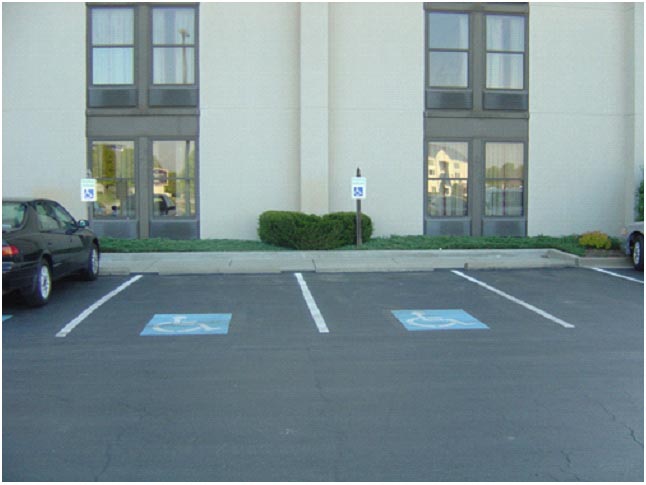 |
| What is wrong in this picture? |
Solution: http://www.ncpad.org/275/1738/Answers~to~the~Accessibility~Problem~in~the~First~Photo