
- Introduction
- Overview of the Study
- The Survey Instrument
- Findings of the Study
- Site Accessibility - Findings
- Management and Operations - Findings
- Challenge Course Facilitator Competencies - Findings
- Inclusive Activity Management
- Belayed and Non-Belayed Activities - Findings
- Risk Management and Related Safety
- Conclusions and Recommendations
- Recommended Challenge Course Staff Training Topics
- About the Article
- About the Author
- Community Voice: The Thrill of the Slope
- Reporters Often Miss the Bigger Picture
- Access Board Issues New Accessibility Guidelines
- Play Areas Designed for Access
- Providing Inclusive Recreation Opportunities: The Cincinnati Model
- Parks and Recreation Budget Cuts "Phase" Accommodation
- Open Spaces: No Bounds to Outdoor Recreation
- Museums, Zoos and Aquariums - Enhancing Accessibility
- Rehab and Community Physical Activity - When and Where Shall the Two Meet?
- Prescribing Physical Activity for People with Disabilities Requires More than General Guidelines
- Current injury or disability as a barrier to being more physically active.
- 2009 All Abilities Team - Chicago Breast Cancer 3-Day
- No Limits on Fitness At Crosstrainers Gym
- A Mother's Untold Story: Need for Better Physical Education for Children with Disabilities
- Do As I Say Not as I Do: Not the Right Attitude for a Rehab Conference
- Injuries among US children with different types of disabilities
- What do you know about the ADA?
- Without Health Promotion, the Health Care System Will Remain Broken for People with Disabilities
- Congratulations Mr. President!
- Responses to the Accessibility Problem in the Photo - 4
- Focus on Secondary Condition Prevention: Universal Design and Accessibility Issues that Impact Health and Function for All
- Exercise can reverse quadriceps sensorimotor dysfunction that is associated with rheumatoid arthritis without exacerbating disease.
- Fitness Vacations
- Finding Accurate Information on Nutrition and Disability Can Be a Real Challenge
- Community Spotlight: Seattle Children's PlayGarden
- Young Athletes with Disabilities Grow Into Healthy Adults
- Environmental Disability
- The Tipping Point
- Newspaper Misses Mark in Health Club Feature
- Strong Headwind on the Road to Accessible Fitness and Recreation
- Secondary Condition Prevention: Building Your Own "Health Empowerment Zone"
- Choosing a Fitness Center
- Active and Inclusive Family Vacations
- Can You Identify the Accessibility Problem In this Photo - 1?
- Opportunities to Advocate for Inclusion in Fitness and Recreation
- MODEL FACTSHEET
- Children with Disabilities and Obesity
- Physical Activity for the Chronically Ill and Disabled
- Answers to the Accessibility Problem in the First Photo
- Children with Disabilities Missing on America's Playgrounds
- Russian Paralympians Outperform Their Olympic Counterparts and Draw Attention to Disability Issues
- Adoption of the Revised ADA Standards for Accessible Design What it Means to Recreation Facilities
- What to Know Before You Go: The Big Questions to Ask Before Arriving at Your "Accessible" Recreation Destination
- Obesity Rates in Youth with Disabilities
- Retrofitting an Accessible Whitewater Park
- Camping, Backpacking, and Hiking
A challenge course program has features similar to any other recreation service delivery operation. There are administrators who must plan and make decisions, marketing and public relations efforts, supervisors directing front-line operations, and program delivery staff who have direct contact with participants. Spread across these functions are responsibilities for risk management, staff training, environmental concerns, and program quality. In the delivery of challenge course programming that includes people with disabilities, it is necessary to evaluate the operation in its entirety to determine an agency's readiness to begin serving these persons.
![]() |
|
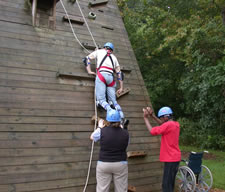
A participant wears extra protection gear and receives support from the facilitator. Photo courtesy of Bradford Woods.
|
Given the vague nature of standards in this field with regard to accessibility and the general incompatibility of the Americans with Disabilities Act Accessibility Guidelines with the challenge course environment, there is a need for specific information on how to design, manage, and deliver safe, effective challenge course-based programming that includes participants with disabilities. This monograph reports on research done by the UAD in 2003 and 2004. Findings from this research will hopefully aid challenge course managers and facilitators in their efforts to include participants with disabilities.


